
Full Foundation Action September/October Newsletter Now Online

All articles from the September/October issue of Foundation Action are now online.
In this issue:
- Cornell Graduate Students Launch Cases Attacking Campus Union Boss Power
- Coca-Cola Driver Files New Case to Overhaul Federal Standards on Dues for Politics
- MI Construction Worker Urges Appeals Court to Defend Workers’ Right to Remove Unions
- Foundation Files Brief Defending Wisconsin Act 10 Reforms From Spurious Union Lawsuit
- Louisiana Poultry Employee Launches Case to End ‘Contract Bar’
- Electrician Slams Union Bosses with Federal Charges Following $1.29 Million Retaliatory Fine
- Join Today to End Forced Unionism in the Workplace
Recent articles can be found here. To sign up for a free copy of the newsletter via mail please see the form at the bottom of the page.
Full Foundation Action November/December Newsletter Now Online

All articles from the November/December 2025 issue of Foundation Action are now online.
In this issue:
- Foundation Brief Defends Trump Order Slashing Federal Government Union Boss Power
- Starbucks Barista Asks NLRB to End Biden-Era Ruling Blocking Votes to Remove Union
- Labor Day 2025: National Right to Work in the News
- Dispensary employees free from a union are the future for Missouri
- Workers Nationwide Push for Expanded Protections Against Forced-Dues-for-Politics
Recent articles can be found here. To sign up for a free copy of the newsletter via mail please see the form at the bottom of the page.
Full Foundation Action July/August Newsletter Now Online
All articles from the July/August 2025 issue of Foundation Action are now online.
In this issue:
- Farmworkers in NY & CA Challenge Union Power Grabs in Federal Court
- Chicago Worker Seeks to Tear Down Biden-Era ‘Blocking Charge’ Policy
- Hundreds of Sunoco Logistics Drivers Give Steelworkers Union the Boot
- Foundation Launches Groundbreaking Legal Aid Campaign Against UNITE HERE
- Charlene Carter Triumphs Over Southwest and TWU Union Again at Fifth Circuit
- WA Employee Kick-Starts Prosecution of AFSCME Bosses for Janus Violations
Recent articles can be found here. To sign up for a free copy of the newsletter via mail please see the form at the bottom of the page.
Full Foundation Action May/June Newsletter Now Online
All articles from the May/June 2025 issue of Foundation Action are now online.
In this issue:
- Workers Nationwide Urge Trump NLRB to End Policies Trapping Them Under Union Power
- Cincinnati-Area Kroger Worker Secures Victory Against Illegal Union Dues Deductions
- AT&T-BellSouth Workers Challenge Union-Concocted ‘Window Period’ Restrictions on Ending Dues
- Trump Was Right to Tell Biden Labor Board Appointee “You’re Fired!”
- NY Healthcare Worker Asks Labor Board to Unblock Vote to Oust SEIU
- Foundation-Backed Baristas Support Trump’s Firing of Biden NLRB Member
Recent articles can be found here. To sign up for a free copy of the newsletter via mail please see the form at the bottom of the page.
Foundation-Backed Starbucks Baristas Support Trump’s Firing of Biden NLRB Member
The following article is from the National Right to Work Legal Defense Foundation’s bi-monthly Foundation Action Newsletter, May/June 2025 edition. To view other editions of Foundation Action or to sign up for a free subscription, click here.
Starbucks employees’ challenge to agency power boosted by firing of Biden Board Member
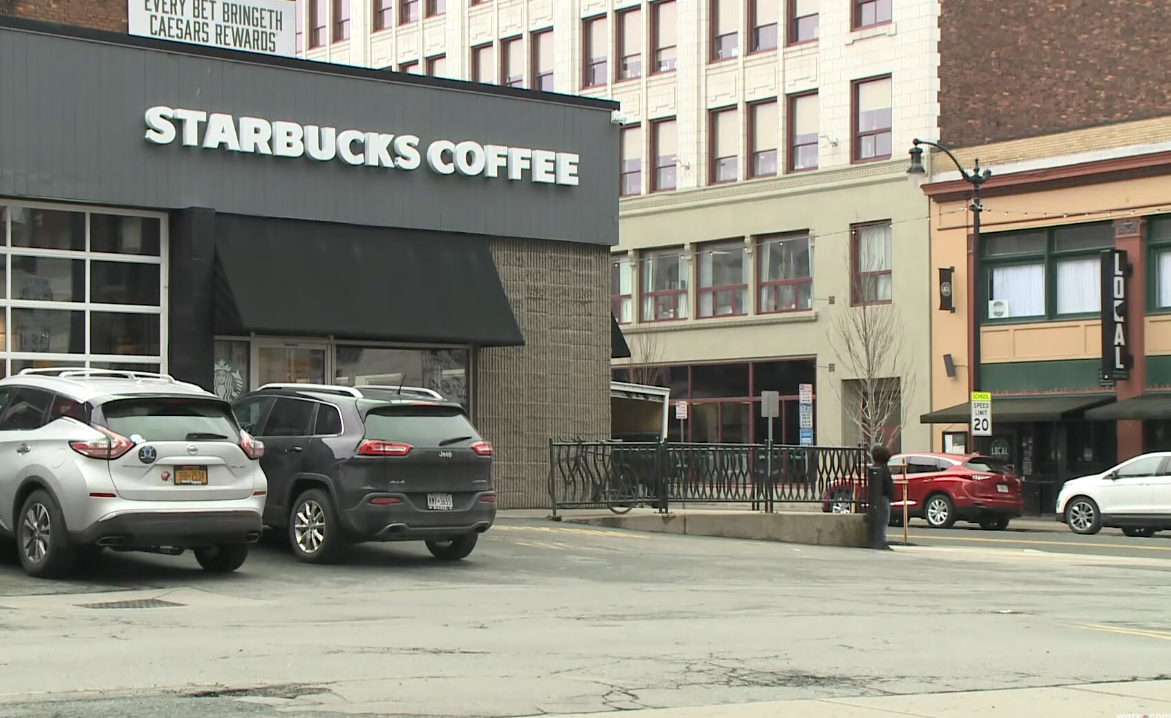
It may not look like much, but this Starbucks store in downtown Buffalo, NY, is the place where barista Ariana Cortes started her trailblazing legal battle against both the SBWU union and a hostile NLRB bureaucracy.
WASHINGTON, DC – President Trump isn’t the only person seeking reform in the federal government. Several National Right to Work Foundation-backed workers have advanced lawsuits in federal courts challenging the constitutionality of a federal agency.
Two upstate New York Starbucks baristas (Ariana Cortes and Logan Karam), represented by Foundation staff attorneys, filed the first case in the nation challenging NLRB members’ removal protections. Their case advanced a revolutionary argument that the National Labor Relations Act’s (NLRA) removal protections for NLRB members — which protect them from presidential removal during their entire terms except in very rare cases — let them exercise executive power in violation of separation of powers doctrines in Article II of the Constitution.
This power is plain to see — unelected NLRB members have the power to decide who can vote in union elections, adjudicate disputes between employers and unions, impose one-size-fits-all union “representation” on employees who don’t want it, and much more. Showdown Over Removal of Biden Appointee Headed for SCOTUS President Trump utilized the same arguments when he announced he was ousting Biden-appointed NLRB member Gwynne Wilcox (a former SEIU union lawyer) for issuing radical decisions that “vastly exceeded the bounds” of federal law.
Wilcox’s lawyers sued Trump over the removal, arguing — wrongly — that NLRB members’ removal protections are valid and prevent the President from doing virtually anything to stop NLRB members who have gone rogue. The case between President Trump and Gwynne Wilcox has now joined Cortes and Karam’s suit in being considered by the D.C. Circuit Court of Appeals.
As this issue goes to print, the Supreme Court has ordered Wilcox off the NLRB while it decides whether Wilcox should remain off the NLRB while the case is ongoing. Foundation attorneys submitted a legal brief on behalf of Cortes and Karam backing the President’s contentions. Cortes and Karam’s brief focuses on how the Board’s powers to enforce federal labor law, lack of technical expertise, and the partisan nature of its membership are not characteristics of a federal agency where removal protections might be appropriate under Supreme Court caselaw.
The brief also argues that reinstating Wilcox would cause chaos because it would let her participate in deciding cases before the NLRB while her continued presence on the Board is still the subject of litigation.
“Cortes and Karam have a vital interest in the outcome of this case, and not only because it concerns the constitutionality of [NLRB member removal protections],” the brief says. “Cortes and Karam do not want an individual the President properly removed from the Board because of her unsound rulings — Gwynne Wilcox — to decide their pending NLRB cases.”
Because of the weighty constitutional matters at stake, many have already predicted that this question will likely receive final consideration from the U.S. Supreme Court. Cortes and Karam’s lawsuit is fully briefed at the D.C. Circuit Court, and a hearing is scheduled for May. Their case was spurred by NLRB bureaucrats’ decision to block the baristas and their coworkers from exercising their right to vote to decertify (or remove) Starbucks Workers United (SBWU) union officials.
NLRB Region 3 rejected petitions in which a sufficient number of coworkers from both Cortes’ and Karam’s upstate New York Starbucks locations requested such elections. Regional NLRB officials cited unfair labor practice accusations made by SBWU union officials against the Starbucks Corporation as the reason for barring the votes. Notably, there was no established link between these allegations and the employees’ decertification requests.
Starbucks Baristas’ Battle Promotes Liberty for Workers Across Country
“Ms. Cortes and Mr. Karam spoke up on behalf of untold numbers of independent-minded workers nationwide when they filed their federal lawsuit challenging the NLRB’s constitutionality,” commented National Right to Work Foundation Vice President Patrick Semmens.
“The NLRB regularly stops workers from exercising their rights to push back against union influence for any reason union bosses dream up. Board members’ ability to do this without fearing any accountability to the elected President has effectively turned the agency into a fourth branch of government.
“We hope the Starbucks baristas’ lawsuit, boosted by the President’s efforts to reform the government, eventually results in lasting change to the Board that protects worker freedom,” Semmens added.
Philly-Area Manufacturing Employees Triumph Over UAW Intimidation Campaign
The following article is from the National Right to Work Legal Defense Foundation’s bi-monthly Foundation Action Newsletter, January/February 2025 edition. To view other editions of Foundation Action or to sign up for a free subscription, click here.
UAW bosses now required to attend federal training after trying to fire non-striking workers
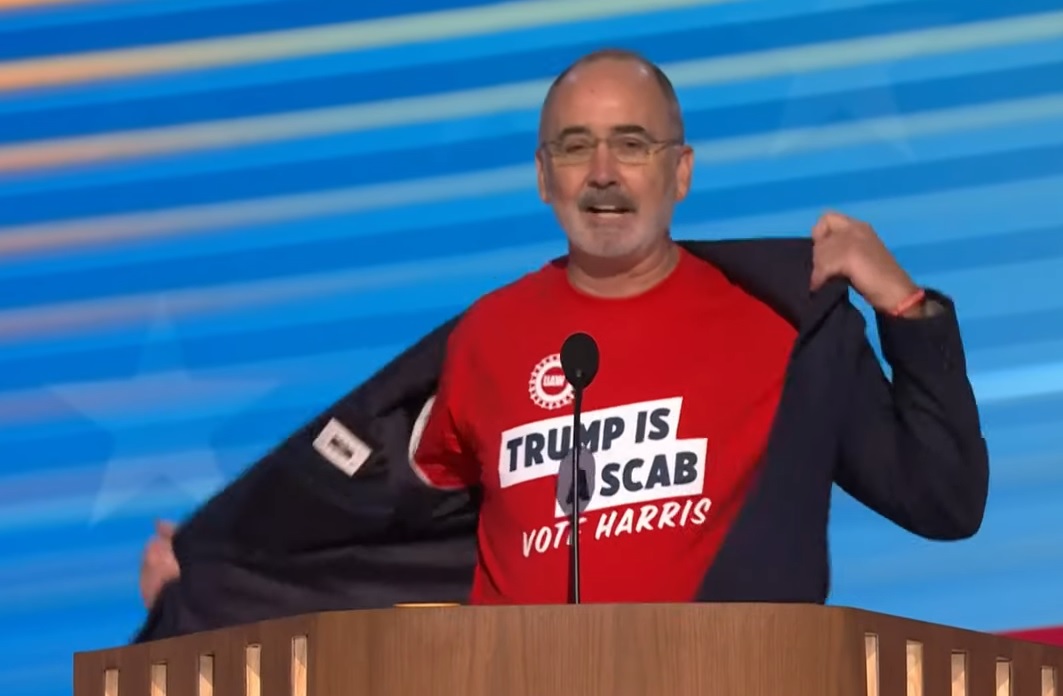
Despite an active federal corruption investigation, UAW President Shawn Fain and his underlings continue to push a radical political agenda using workers’ dues money while ignoring the rights of the rank-and-file employees union bosses claim to “represent.”
PHILADELPHIA, PA – It’s not particularly difficult to see why United Auto Workers (UAW) union officials are having trouble convincing workers that the union has their best interests in mind.
The union’s upper echelon is still reeling from a federal probe that hit about a dozen top union bosses with prison sentences for embezzling workers’ dues, and to this day it appears that UAW President Shawn Fain — a so-called “reformer” — is being scrutinized by federal monitors for manipulating his position to secure personal benefits.
But the corruption within the UAW goes far beyond the union’s top executives. Throughout 2024, National Right to Work Foundation-backed workers for auto accessory manufacturer Dometic fought illegal UAW demands that they strike or be fired.
UAW Union Used Mass Texts, Social Media to Bully Workers
In March 2024, seven Philadelphia-area Dometic employees filed unfair labor practice charges against the UAW Local 644 union, detailing that UAW bosses had ordered a strike and threatened to get fired anyone who decided to keep working.
Despite the employees’ resignation of their union memberships, UAW officials began internal proceedings against each of them soon after the strike began. Federal labor law forbids unions from imposing internal discipline on those who abstain from union membership.
The Dometic workers didn’t back down. With free Foundation legal aid, all the workers won settlements in October 2024 that fully vindicated their rights. UAW officials must now make postings correctly informing workers of their right to abstain from union activities, and the settlement even requires union chiefs to undergo mandatory training on the limits of “a union’s right to impose internal discipline,” among other topics.
As the workers’ legal battle dragged on, the Dometic workers continued to expose ugly details of the UAW’s intimidation campaign surrounding the strike. In April 2024, Dometic employee Mario Coccie filed a second round of charges against UAW Local 644 for a mass text message that threatened all Dometic employees — not just those who had filed charges against the union — with termination if they didn’t strike.
“The information in this text reveals union officials’ real intentions, which is to hurt anyone willing to stand up for themselves,” said Coccie at the time. “What is happening in this case is completely unjust.”
UAW officials also refused to respect Coccie and his coworkers’ rights under the Foundation-won CWA v. Beck Supreme Court decision, which prohibits union officials from requiring workers to pay for the union’s political expenditures just to keep their jobs. Because Pennsylvania lacks Right to Work protections for its private sector workers, UAW bosses can force workers to pay union fees as a condition of employment, but must abide by Beck.
Legal Privileges Enable UAW Corruption
In addition to the notice postings and required training, the Foundation-won settlement orders union officials to delete social media posts threatening workers who refused to strike.
“We’re proud to have helped Mario Coccie and his coworkers vindicate their rights,” commented National Right to Work Foundation Vice President Patrick Semmens. “But it has become all too clear that union corruption — which can take the form of anything from stealing millions in worker dues to intimidating workers to join a picket line — is only made easier when union bosses are granted more legal privileges.
“Policymakers need to protect workers’ freedom to cut off funding for union bosses who don’t serve their interests, and to fully abstain from union activities that individual employees do not see as in their own best interest,” Semmens added.
Foundation Op-Ed: ‘Biden’s Labor Board Wants to Trap Workers in Unions they Oppose’
In an op-ed for The Hill published on Labor Day (September 5, 2023) entitled “Biden’s labor board wants to trap workers in unions they oppose,” National Right to Work Foundation President Mark Mix highlighted the coercive pro-union boss policies being pushed by Biden-majority National Labor Relations Board to the detriment of the rights of independent-minded workers:
Big Labor bosses have a problem: Despite their vitriolic rhetoric and a small number of loud online activists, most workers want nothing to do with unions.
A Gallup poll released last Labor Day spotlighted the issue: A strong majority of nonunion workers in the U.S. (58 percent) say they are “not interested at all” in joining a union, whereas just 11 percent say they are “extremely interested.”
Since it takes a majority of workers in a given workplace to support a union before monopoly union representation can be imposed, union organizers face a basic math problem — one that explains why only 6 percent of private-sector workers are unionized today.
Yet rather than consider ways of making unionization more attractive to rank-and-file workers, politically-connected union bosses have a different plan: Rig the rules to force more workers into their ranks, willing or not.
President Biden, who campaigned on being “the most pro-union president in American history” and is counting on Big Labor’s multi-billion-dollar political machine again in 2024, is unleashing his administration to the benefit of his favorite special interest.
The National Labor Relations Board (NLRB), stocked with Biden appointees and former union lawyers, has been busy doing just that. If workers won’t voluntarily vote unions in, Biden’s NLRB, whose rules cover most private sector workers, wants to take their vote away.
That’s why the NLRB, at the end of August, effectively mandated the “card check” unionization process by bureaucratic fiat. Never mind that numerous union-backed measures in Congress to require this abuse-prone unionization process have failed to pass into law.
Card-check drives occur when employers, usually in the face of union-applied political and economic pressure, waive workers’ right to a secret ballot election. During these drives, union officials are allowed to demand union authorization cards directly from workers using coercive tactics that would be unlawful during a secret ballot vote.
Union organizers can show up at workers’ homes over and over again demanding signatures, in some instances requiring workers to call the police to get organizers to leave. Workers report being misled about the true implications of signing the cards, and some have been told they would be fired if they didn’t sign just before the union successfully took over.
Some workers even face threats of violence. In one SEIU organizing drive, a worker reported being told that the union would “come and get her children” and “slash her tires” if she didn’t sign a union card…
Read the rest of Mark’s piece on the website of The Hill here.
Former Connecticut State Trooper Wins Over $250,000 in Political Discrimination Suit
The following article is from the National Right to Work Legal Defense Foundation’s bi-monthly Foundation Action Newsletter, July/August 2023 edition. To view other editions of Foundation Action or to sign up for a free subscription, click here.
CSPU union upended trooper’s career after he refused to fund union politics
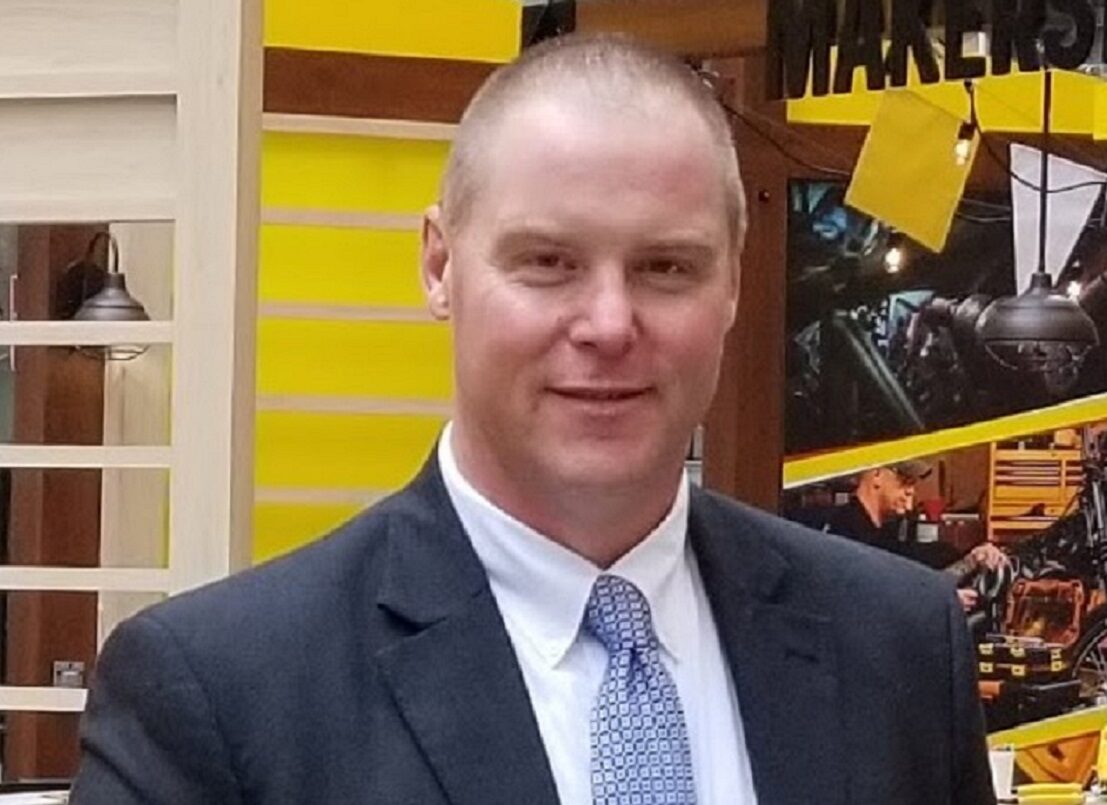
Joseph Mercer fought back with free Foundation legal aid when the CSPU union blocked his promotion because he challenged union political activities and told others about their rights.
HARTFORD, CT – In 2015, then-Connecticut State Trooper Joseph Mercer received a promotion to Operations Sergeant of the Emergency Services Unit, a position that gave him significant responsibility over emergency services training and field operations. Mercer gained this prestigious position through his seventeen years of experience as a trooper, which included a tense situation with an armed suspect barricaded in a hotel.
But behind the scenes, Mercer was a target of Connecticut State Police Union (CSPU) officials, who resented Mercer because of his resistance to funding union politics with his own money. After CSPU President Andrew Matthews filed two baseless grievances against Mercer, the Department of Emergency Services and Public Protection (DESPP) demoted him to a position that offered fewer overtime opportunities and involved less time in the field.
Mercer slammed CSPU and DESPP officials with a federal lawsuit in 2016 with free legal aid from the National Right to Work Foundation, accusing police union officials of retaliating against him for exercising his right to stop funding union politics.
This April, Foundation attorneys forced CSPU and DESPP to back down and settle the case. Both parties must now pay $260,500 as a condition of ending the suit.
CSPU Union President Targeted Dissident Trooper Immediately After Promotion
Just a month after Mercer received his promotion, CSPU President Matthews filed a grievance over Sergeant Mercer’s appointment.
Matthews’ grievance claimed that there had been no “selection process” to fill the position, despite the fact that none of Sergeant Mercer’s union-member predecessors had undergone any particular kind of selection process before they got the job. Matthews also filed a second baseless grievance, alleging Mercer had mismanaged the incident involving the armed suspect barricaded in a hotel. State police officials had never expressed dissatisfaction with how Mercer handled the situation.
In October 2015, after meeting in private with the union president, then-DESPP Commissioner Dora Schriro transferred Mercer out of his Operations Sergeant position to an administrative post. Prior to this demotion, Mercer had received no warnings, reprimands, or other disciplinary actions regarding the incident referenced in Matthews’ grievance. Mercer filed his lawsuit with Foundation aid in February 2016.
Mercer’s Foundation attorneys cranked up the heat on both the union and DESPP officials in May 2022, when a District Court judge ordered DESPP Commissioner James Rovella, who had replaced Schriro, to turn over additional documents that might provide insight into the circumstances surrounding Mercer’s firing.
Rather than follow through with the judge’s discovery order and continue the fight against Mercer, CSPU and DESPP reversed course and settled the case in April 2023. The settlement categorizes the vast majority of the $260,500 payout as “compensatory damages” due directly to Mercer.
Settlement Underscores Importance of Public Servants’ Janus Rights
“We are proud to have defended Sergeant Mercer’s rights and secured him a settlement that vindicates his free association,” commented National Right to Work Foundation Vice President and Legal Director William Messenger. “However, it’s disgraceful that CSPU union officials targeted Mercer, a dedicated public safety officer, with such a retribution scheme in the first place. Public servants should not have to endure multi-year lawsuits just so they can refrain from supporting union politics they oppose.”
“Situations like these demonstrate why the Foundation-won Janus v. AFSCME decision, which the U.S. Supreme Court decided while Mercer’s case was ongoing, is so important,” Messenger added. “As demonstrated in Mercer’s case, unelected union officials often wield their enormous clout over government to serve the union’s self interests over the public interest and employee interests. That’s why it’s vital that public employees can exercise their First Amendment Janus right to cut off all financial support for union officials this way.”
Busted: Kroger Worker’s Card Illegally Altered to ‘Authorize’ Forced Dues
The following article is from the National Right to Work Legal Defense Foundation’s bi-monthly Foundation Action Newsletter, May/June 2023 edition. To view other editions of Foundation Action or to sign up for a free subscription, click here.
Employee’s UFCW union card indicating objection to financial support changed without her knowledge

Jessica Haefner clearly exercised her rights under Texas’ Right to Work law. Foundation attorneys will get to the bottom of who faked her consent to dues deductions and restore her rights.
HOUSTON, TX – Supermarket clerk Jessica Haefner began her job at a suburban Houston Kroger store in August 2022. She attended a mandatory meeting for new employees run by United Food and Commercial Workers (UFCW) local union agents. Despite the union’s hard-sell at the meeting, she knew her rights under Texas’ Right to Work law: Union bosses couldn’t force her to pay any dues or fees to the union to keep her job.
During the meeting, Haefner followed a union representative’s instructions to indicate on a union form that she did not want to be a part of the union or pay dues or fees. But she was shocked to discover just weeks later not only that union dues were coming out of her paycheck, but also that the union form she was required to sign had been altered to indicate she consented to those deductions.
Haefner, with free legal representation from National Right to Work Foundation staff attorneys, slammed UFCW officials and Kroger with federal charges at the National Labor Relations Board (NLRB). The charges state that UFCW bosses’ and Kroger’s actions violate her rights under Section 7 of the National Labor Relations Act (NLRA), which guarantees American private sector workers’ right to abstain from any and all union activities.
“I was lied to . . . and my rights were not only violated as an employee but as an American citizen,” said Haefner.
Employee’s Dues Form Was Altered, Forced Dues Deductions Began
According to Haefner’s charges, a UFCW agent passed out a union membership application and a dues checkoff on a single form that he claimed was mandatory for meeting attendees to complete. Another piece of onboarding literature stated that Kroger management had the “opinion that you should participate and be active in the Union.”
When Haefner asked how she could exercise her right to refrain from joining the union or paying union dues, the union agent instructed Haefner to write “$0” in the field marked “union dues” on the form.
Haefner followed these instructions. But after discovering later that union dues were indeed coming out of her paycheck, Haefner quickly obtained a copy of the form on which Kroger and UFCW officials based their dues deductions. She saw that someone had changed the dues deduction amount in the field she marked “$0” to a dollar amount to induce dues deductions from her paycheck.
UFCW Chiefs Illegally Seizing Dues from Grocery Workers Across Country
UFCW’s violation of Haefner’s rights is not an isolated incident. In Pennsylvania, Foundation staff attorneys are also representing Giant Eagle supermarket cashier Josiah Leonatti, who charges UFCW Local 1776KS union officials with refusing to accommodate his religious objections to union membership (see page 3). King Soopers grocery employees from Colorado are also receiving free legal aid from Foundation staff attorneys in opposing illegal UFCW strike fines, some of which are as high as about $4,000 per worker.
“Jessica Haefner knew her rights under Texas’ popular Right to Work law and actively asserted them, yet UFCW union officials still brazenly took her money against her will,” commented National Right to Work Foundation President Mark Mix.
“As cases brought for workers with free Foundation legal aid show, UFCW bosses have a long and documented history of violating workers’ rights, whether through thousands of dollars in illegal strike fines, illegal religious discrimination, threatening teenagers’ jobs, and now by altering a worker’s dues authorization,” Mix added.
Full Foundation Action March/April 2023 Newsletter Now Online
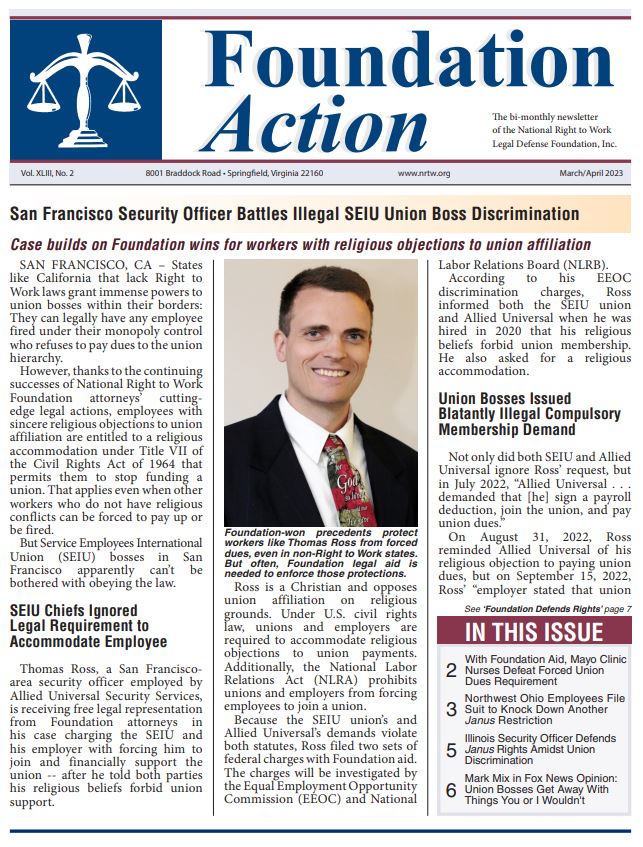
All articles from the March/April issue of Foundation Action are now on the website.
In this issue:
- San Francisco Security Officer Battles Illegal SEIU Union Boss Discrimination
- With Foundation Aid, Mayo Clinic Nurses Defeat Forced Union Dues Requirement
- Northwest Ohio Employees File Suit to Knock Down Another Janus Restriction
- Illinois Security Officer Defends Janus Rights Amidst Union Discrimination
- Mark Mix’s Fox News Op-Ed: “Union bosses get away with things you or I wouldn’t. Supreme Court should roll back special privileges”
Recent articles can be found here. To sign up for a free copy of the newsletter via mail please see the form at the bottom of this page.





